"
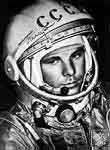
The king (as figurehead, as sun god) was formulated in the figure of astronaut
Juri Gagarin. Statues of him ascending to the stars, a kind of cyborg Christ,
were erected all over the country….the whole state was a time capsule of
utopian ideas, the stalinist metaphysic involving a complete fusion of the virtual
and the real, with the virtual understood as not merely the potentialities of
digital communication but as the dynamic realm of latent possibility for organisation
and communication that inhabits the body of any socius."
The background to the work was a film I had started to make which involved mixing elements from environmental video, sound, and Flash movies. A great deal of technical difficulty ensued- particularly around the issues of text exported to Quicktime from Flash, and the difficulty of video in dealing with high saturation reds. This was gradually sorted out, and the film became a mixture of the world inside the head, the goals and realities of the "New Town" and a reconnaissance of the past. For me the space age happened in the living rooms and school playgrounds of the world, at least as much as in laboratories and on rockets. I grew up in Glasgow and Cumbernauld: I considered the transition to be my first taste of astronaut training. "Weightless, free of history, new youth look to the future… For this is the future-and it’s very badly built…"
I took a sense of optimism and childhood identification with Gagarin and produced a film that blends video footage, propaganda soundtracks, and self-made animations. I wanted to see how far I could go with emotional tone without becoming too sentimental.
As the anniversary of his flight approached, I remembered that I’d had a space party on the 12th April 1991 in my flat in Hampstead, and that it had been one of the best parties I’d ever done. The idea of taking it further and producing a celebration with other artists seemed very positive.
The Gagarin event became a project to enable many artists to work together on something, to see how our different interests could complement each other around a common starting point. It brought together artists from around Europe: Poland, the Netherlands, Blantyre, Melbourne, Dundee, and London. It brought an eminent professor of Art History (Martin Kemp) into debate with an astronomer, artists, and the public. To commemorate the day in which the world was seen for the first time by a human eye as one spherical whole, a small helium airship was flown around the DCA foyer space, transmitting a view of that space as never seen before. An exhibition was mounted in two places; still images and video in the VRC corridor, and interactive/sound pieces in the Generator Space in a party atmosphere.
I wondered if an event based around a celebration of a previous world-uniting technology would bring forward any interesting points about the world-uniting possibilities of contemporary imaging. For me, what it emphasised was the potential for fluidity between media and participants.In addition, I have become very aware of the issue of "representing" work across different media. In what sense can the web version of Hans Waanders’ work- personal mail art- stand for the experience of receiving the actual thing? I’m fascinated by the tantalising promise of digital imaging which by definition can never actually deliver- but somehow that doesn’t raise itself as a problem for the viewer.In addition I became aware that I was not alone in wanting to make something of this date. A worldwide network of more than 50 Juri parties had come into being. This network would eventually spread to all seven continents, with a party at the Scott/Amundsen base in Antarctica.
Gagarin day seems to have been a success, but I am disappointed that it proved impractical given the time available to arrange some public projection pieces. Similarly a call for live/performance pieces for the day met with initial enthusiasm but failed to bear fruit. While trying to anticipate possible consequences of the Gagarin day I did wonder if it would bring some diehard Stalinists out of the woodwork to celebrate the mighty days of the Soviet Union, but no such people materialised. Where have they all gone?