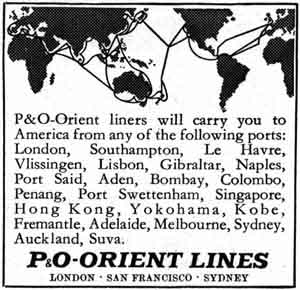
Note the contrast with mapping from previous travel modes; the worlds shipping lines. The following image comes from the same magazine, which shows the overlapping nature of these paradigms.
Here a rigid worldview based on standard Mercator projection is the dominant proposition. Countries and routes exist in highly determined fixed relations. Ports are listed, offices specified. Indeed, the over-determination is such that Europe is doubled- as a twin nexus, both east and west. In this form of mapping, timezones are easily and directly readable as vertically successive bands, reflecting the importance of time separations and calculations based on them. The aero company maps, by contrast, flaunt the irrelevance of time zones and promise easy mastery of time and distance.
The Internet Explorer and the Netscape trademarks, in contrast, have shrunk the world so that the trace or track is erased, transcended.


The World- bestriding " N" of the netscape navigator logo makes a step without specific path: the internet explorer planet once showed the western hemisphere (and the edge of Europe) but now makes a logoplanet of the letter e in a way familiar to designers working for Boeing and NASA. It brings forward a clean vision of cosy world unity, a mission statement in one ideogram. Instead of geography, we are invited to identify with a circular orbit: we are going to inhabit circulation rather than location. Timelessness and immediacy are connoted: a world where geotime intervals are without relevance. A world reduced to an iconic reminder designed for a small screen. The implicit message that you might as well be anywhere, so what’s the point of actually going? At one time, the experience of being abroad was encapsulated in the comic vision of the travelling photographer too busy looking through the viewfinder to really live in the present. Now travellers spend an appreciable amount of time in internet cafes, mixing with their own kind, following a prescribed path from fashionable guidebooks, and looking for the expected experience. Travel becomes another extension of the call centre.For commerce and the image inflected by the "new creative industries"- whether on television or in a game scenario- the great taboo is not that one may become bored but that one might change channel.
A breathless acceleration
of sensation crowds out that possibility by compressing game-time into a simulation
of life or death struggle; a policy of mobilization, with real-world action
indefinitely deferred. Psy-ops translated from the strategic thinking of the
1960s- the Rand Corporation, etc, to the recruitment and mobilisation of the
individual. Foucaults’ disciplinary grid shifts from the body in ordered
space to a hierarchic goal-oriented mental arena, a metonymy of the collapsed
role of the citizen.